


Access Denied
IMPORTANT! If you’re a store owner, please make sure you have Customer accounts enabled in your Store Admin, as you have customer based locks set up with EasyLockdown app. Enable Customer Accounts

1
/
of
1
ARCHIVE
Buku Able Anaerobic-Guji, Ethiopia
Buku Able Anaerobic-Guji, Ethiopia
1 review
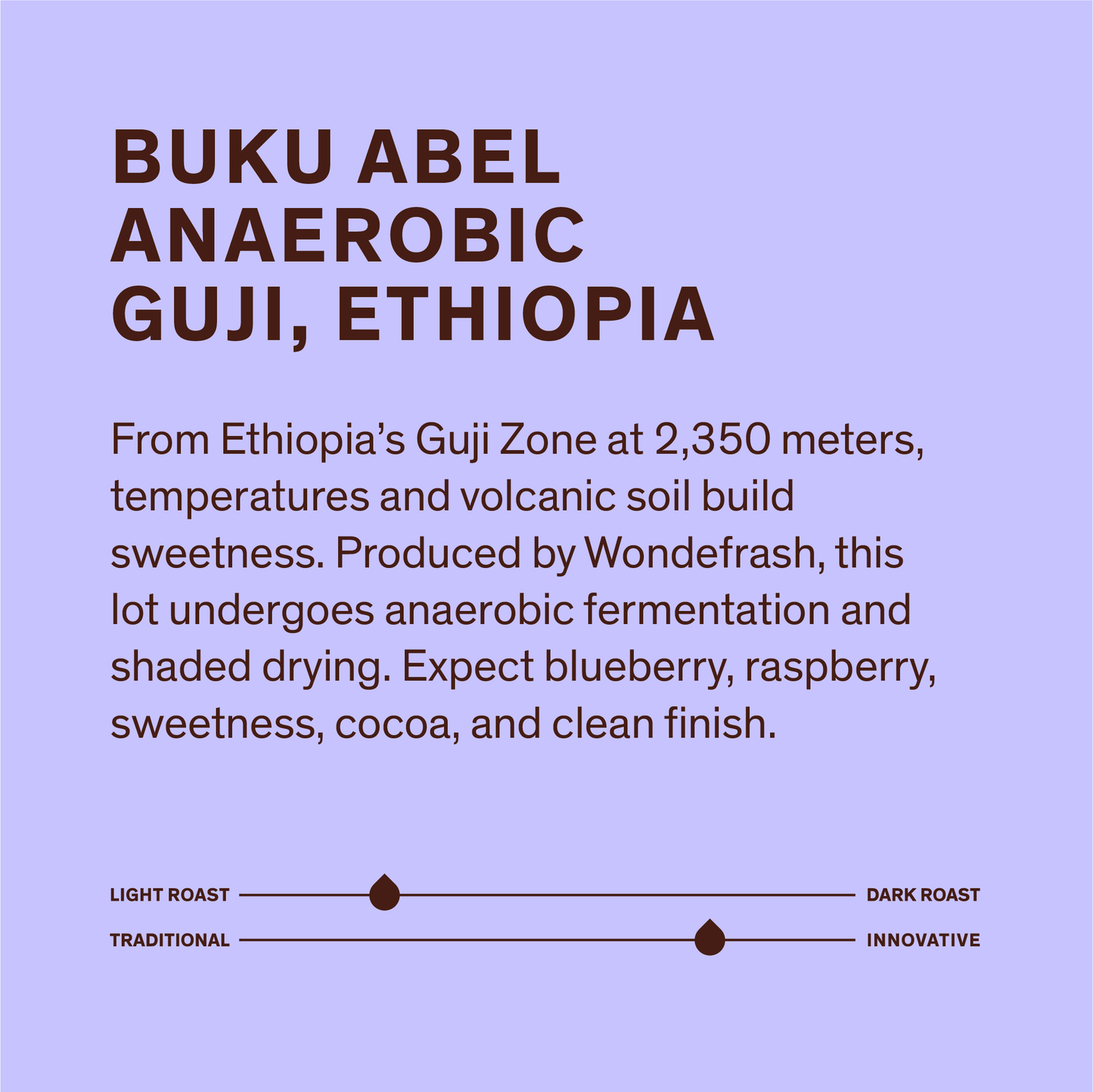
Buku Abel sits high in the Hambella area of Ethiopia’s Guji Zone, around 2,350 meters above sea level. That elevation shapes the coffee. Cool temperatures, red volcanic soil, and wide swings between day and night slow the cherries’ development, building natural sweetness and structure. Coffees from this part of Guji are expressive and fruit-forward.
This lot comes from Wondefrash, who manages the Buku Abel washing station and works closely with local smallholders. After Ethiopia changed its export regulations in 2017, he made the move from exporting to production, officially launching Buku Abel in 2019. Since then, his focus has been on consistency, not novelty especially when it comes to anaerobic fermentation.
This coffee represents Wondefrash’s third harvest refining his anaerobic process. Early experiments tested different fermentation lengths, but over time he dialed it in to what actually makes the coffee better, not louder. Today, he sticks with a 72-hour sealed anaerobic fermentation. The result: depth and sweetness without losing clarity or balance.
The variety here is 74165, a JARC selection bred for high elevations and slow, even maturation. Cherries are hand-picked at peak ripeness, carefully sorted, and sealed in oxygen-free tanks. After fermentation, the beans are slow-dried on raised beds under shade, protecting structure before resting.
In the cup, this coffee is controlled and fruit-forward. Think blueberry and raspberry notes, a jammy sweetness balanced by soft cocoa and chocolate undertones. Aromatics are vivid, but the finish stays clean. It’s expressive without ever feeling over the top a true anaerobic coffee that still tastes like coffee.
Buku Abel Anaerobics have become something of an industry favorite, and this harvest continues that trend. It’s a clear example of what happens when strong raw ingredients, high elevation, and thoughtful processing come together. This coffee knows what it’s trying to be and it does it well.
A bit about the variety: 74165 was developed by the Jimma Agricultural Research Center in the mid-1970s, during a time when coffee berry disease was putting serious pressure on farmers. The numbering simply reflects its selection history it’s not a flashy trade-named cultivar, but a locally adapted Ethiopian variety chosen for consistency and performance in the field. Think of it as a refined heirloom rather than something engineered.
JARC selected 74165 from hundreds of indigenous mother trees, prioritizing disease resistance, reliable yields, and solid cup quality. The goal wasn’t to reinvent Ethiopian coffee, just to help farmers protect what already worked. That’s why 74165 thrives in demanding high-elevation regions with high-quality potential. Today, you’ll find it across specialty lots from Guji, Yirgacheffe, Sidamo, and Jimma. Naming it isn’t a flavor promise terroir, altitude, and processing still do the heavy lifting but its track record shows that when grown and handled well, 74165 supports clean structure, layered sweetness, and expressive cups year after year.
Slow drying isn’t new it’s how Ethiopian naturals have been processed for decades. What’s different now is patience and control. Instead of rushing cherries through two or three weeks of sun drying, producers stretch the process to four to six weeks and sometimes more, often using shaded raised beds or roofs to manage airflow and humidity. The goal is simple: to let moisture move evenly through the beans, avoid cracks or uneven drying, and finish fermentation cleanly. Slow drying gives beans uniform structure, fewer defects, and a cleaner appearance.
The payoff is in the cup. Slow-dried Guji coffees show brighter, more defined fruit notes, balanced sweetness, and a refined body without jagged or harsh fermentation flavors. Extended drying also stabilizes the beans, making them easier to store while keeping aromatics intact. It’s a patient approach, but it makes a difference you can see, smell, and taste. Simply put, slow drying takes good coffee and makes it consistently better
O
Olaf S. Buku Able Anaerobic-Guji, Ethiopia
Invalid password
Enter